









Bullish market movement
Corn futures contracts surpassed a one-year high on The Chicago Board of Trade (CBOT), reaching $484 per bushel (approximately 25 kg of corn) on January 20, 2025.* This is a sharp, nearly 24 percent increase since last August. Still, the price is down 40 percent from its all-time high of $813 per bushel*, which could indicate further upside potential.[1[ Corn traded 8 percent higher on the CBOT on the day in question compared to the same period last year, while from a 5-year perspective, it is up 30 percent.*
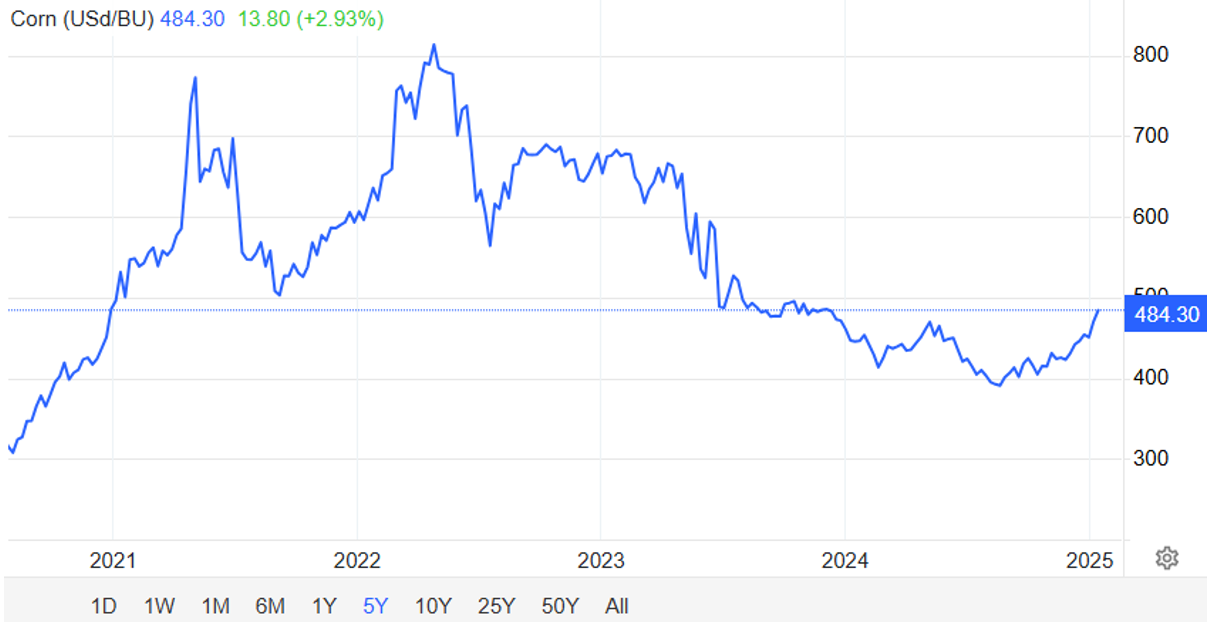
Price movement of corn futures contracts on the CBOT over the past 5 years. (Source: Trading Economics)*
Price jump due to the Department's outlook
The bullish sentiment in the corn market was mainly triggered by the latest outlook from the U.S. Department of Agriculture. The report, released on January 10, 2025, revealed lower expectations for US corn supplies, production and yields in the current 2024/2025 season. According to Food Business News, USDA lowered the estimated supply level of the crop by 11 percent compared to December projections, while production is expected to be down 1.8 percent. At the same time, the average yield is also expected to be reduced, by about 2 percent. Adding to the unease among growers is the uncertain situation surrounding the new U.S. president, whose potential trade war and increased tariffs could significantly affect the agricultural sector.
Little consolation for the fields
The weather forecast in Argentina, where rainy days were expected to somehow help parched maize fields, also contributed to the positive development. The country, which is the third largest global supplier of maize, has been struggling for several weeks with a dry period attributed to the La Niña atmospheric phenomenon, which brings cooler weather in December along with heatwaves. Despite the negative impacts of the weather pattern, this year's, as the National Oceanic and Atmospheric Administration has described it, is weak and unusual. At the same time, the bureau said in its January 9, 2025, statement that La Niña is projected to persist through April. The events resulted in Argentina's Rosario grain exchange lowering its full-year crop forecast for the current season by 2-3 million tonnes, to 48 million. It also said that the combination of weather conditions came at a very critical time, and even the rains should not be significant.
A potential problem for consumers as well
The maize and food industry could also be significantly disrupted by the ban on high fructose corn syrup (HFCS) and seed oils. The ban was proposed by Donald Trump's nominee, Robert F. Kennedy Jr.. From a health perspective in the fight against obesity, this is a positive step, as corn syrup is an additive in many processed foods. From a business standpoint, it's not so rosy. Farmers in areas heavily dependent on maize production would suffer the most. In addition to income losses, there would also be falls in stock market prices. According to Benzinga, about 8 percent of corn goes to HFCS production, and the ban alone would take 1.4 billion bushels of the crop out of production. The ban would also be felt by food manufacturers, from smaller ones to corporations like PepsiCo and Kraft Heinz, who would have to switch to alternative or natural product formulations. Ultimately, any changes would be reflected in increased prices for consumers or in availability. On the other hand, in practice, we can see that many companies are using, for example, traditional sugar instead of HFCS in some markets, which can also be used as a substitute. A perfect example of this 'dual food quality' is for example Coca Cola, which uses HFCS in its beverages in Slovakia, whereas in the Austrian market it is conventional sugar. However, as mentioned above, the resulting change in composition would of course also be reflected in the final price on the shelves.
*Past performance is no guarantee of future results.
[1] Forward-looking statements are based on assumptions and current expectations, which may be inaccurate, or on the current economic environment, which may change. Such statements are not guarantees of future performance. They involve risks and other uncertainties that are difficult to predict. Results may differ materially from those expressed or implied by any forward-looking statements.
