









Trucks without drivers
As part of the collaboration announced by the companies on 4 February 2025, Waabi Driver AI software will be installed in Volvo trucks to improve the safety and efficiency of freight transport. The advantage of Waabi's AI is that, unlike other models, it can simulate and predict situations on the road without having to test them in real time, which means it saves both time and money significantly. In addition, integrating the software into the trucks will improve braking, power and a host of other functions. Vehicles powered by Waabi Driver will begin testing later this year, and the technology will be integrated not only into existing but also upcoming Volvo VNL autonomous trucks, which are being built at Volvo's largest plant in Virginia. Plans to have a VNL truck in the product line were announced by the Swedish company back in May last year, and it has also managed a few test drives in cooperation with delivery company DHL. This is not the first contact with Waabi for the Swedish vehicle manufacturer. Volvo Group's venture capital subsidiary Venture Capital was the first investor in the technology, joined by large enterprises such as Uber, Nvidia and Porsche. Meanwhile, Waabi's AI has been tested before, on a fleet of autonomous trucks from its logistics arm, Uber Freight. Volvo and Waabi are hoping that by working together, autonomous trucks will soon become a common reality.
Volvo is "keeping up with the times"
To keep up with the pace of development, Volvo entered the development of autonomous vehicles in 2017. Two years later, it introduced the Vera electric truck, which it tested in a pilot program in Sweden. In the US market, in addition to DHL, it has partnered with Aurora Innovation, an autonomous technology company, to further develop its capabilities in this area.
The potential is huge
The transport industry can also develop faster and more efficiently because of such innovations as the US logistics industry struggles. According to Freight Waves, some industry professionals are of the opinion that the trucking industry has a driver shortage, while others believe that the problem lies in high turnover due to long hours and inadequate pay. Autonomous vehicles could be a breakthrough solution to this problem. Their potential is evidenced by figures from consultancy firm McKinsey & Co. The latter, in its September 2024 report, estimates that by 2035 the global market for this type of vehicle could be worth USD 616 billion, with the US alone accounting for USD 178 billion. [1]
They want to help drivers
Volvo Buses' public bus subsidiary has taken another step towards a driverless future. In cooperation with VL and Svealandstrafiken, it will launch a new trial system to support autonomous driving for bus drivers in the spring. The tests will be conducted on electric buses on routes in Västerås. However, the system will not replace the drivers, but rather take the pressure off them while improving safety and comfort. It will also automate departures and arrivals at bus stops, allowing drivers to concentrate on traffic. It also promises the economic and environmental benefits that should result from minimising wear and tear on buses. According to Volvo Buses project manager Joakim Jonsson, fully autonomous buses are the big-ticket item of the future. On the contrary. Svealandstrafiken's head of technology and innovation, Geert Schaap, sees other potential applications, for example in guidance to charging stations or washrooms. The tests will last for 6 months and will include a scientific study carried out in collaboration with Chalmers University of Technology to assess its impact on both drivers and passengers.
It's going to be a tough year
Volvo delivered strong financial results last year, with sales up 8 percent and more than 708,000 vehicles sold. Operating income increased 12 percent to SEK 22.3 billion (USD 2.04 billion). The last three months of last year painted a more challenging picture, as the company's profit fell 28 percent to just under SEK 4 billion (USD 366 million). The company justified the drop by citing a downgrade in the valuation of its Novo Energy business, which it owns with Sweden's Northvolt. Sales in the fourth quarter rose just 2 percent with sales up 1 percent compared to the same period in 2023.* In terms of sales, Volvo saw a 6 percent decline in China, and a 2 percent drop in the U.S. The manufacturer's forward-looking statements, however, pointed to a challenging 2025, citing slower market growth, rising discounts and geopolitical uncertainties such as trade tariffs. Although electric car sales rose from 16 to 23 percent last year, public acceptance has been stagnant. Because of that, Volvo in the fall dropped its commitment to all-electric car sales by 2030. But it still has premium hybrid and plug-in hybrid models on offer.
Shares in green numbers
Despite the difficulties in the global market, Volvo has been able to deliver reliable vehicles and innovation, as can be seen in the company's share price on the stock market. They are looking at 5-year performance and are in the green numbers, adding more than 80 percent to their value over the period, despite facing several months of declines in 2022 and 2024. Last year, the shares reached an all-time high, rising to nearly SEK 315 (USD 28.83) in March. As of February 10, 2025, they were trading very close to that level, SEK 312.40 (USD 28.59), on Nasdaq Stockholm. According to Google Finance, as of that date, the market capitalization had reached SEK 635.41 billion (USD 58.1 billion).*
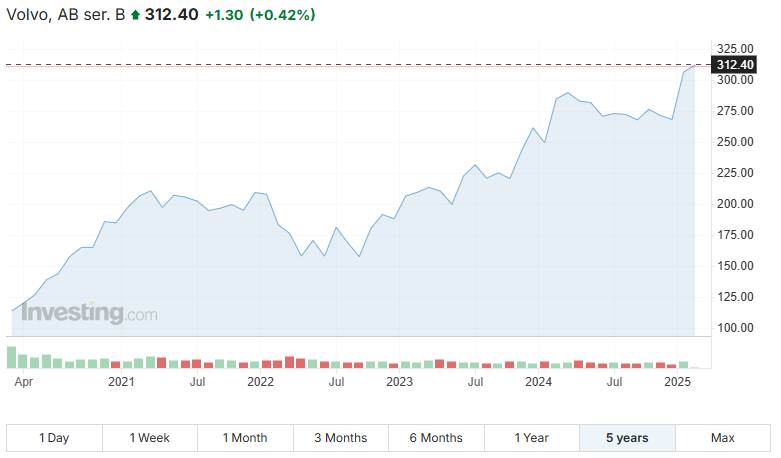
Price development of Volvo shares in SEK over the last 5 years. (Source: Investing.com)*
* Past performance is no guarantee of future results.
[1] Forward-looking statements are based on assumptions and current expectations, which may be inaccurate, or on the current economic environment, which may change. Such statements are not guarantees of future performance. They involve risks and other uncertainties that are difficult to predict. Results may differ materially from those expressed or implied by any forward-looking statements.
