









Sharp Decline
Throughout 2024, cocoa remained strong. Its price reached two peaks during the year, the latest on December 18 at a value of $12,565. However, since the beginning of the year, the commodity has undergone a nearly 30 percent correction, with a sharper decline starting as early as February. The price of continuous contracts on the Intercontinental Exchange (ICE) in New York dropped to approximately $8,200 per ton on March 6, 2023. Despite this drop, the price of the main ingredient in beloved chocolate remains high. Looking at its five-year performance, we can see that over this period, the price has increased by 218 percent.*
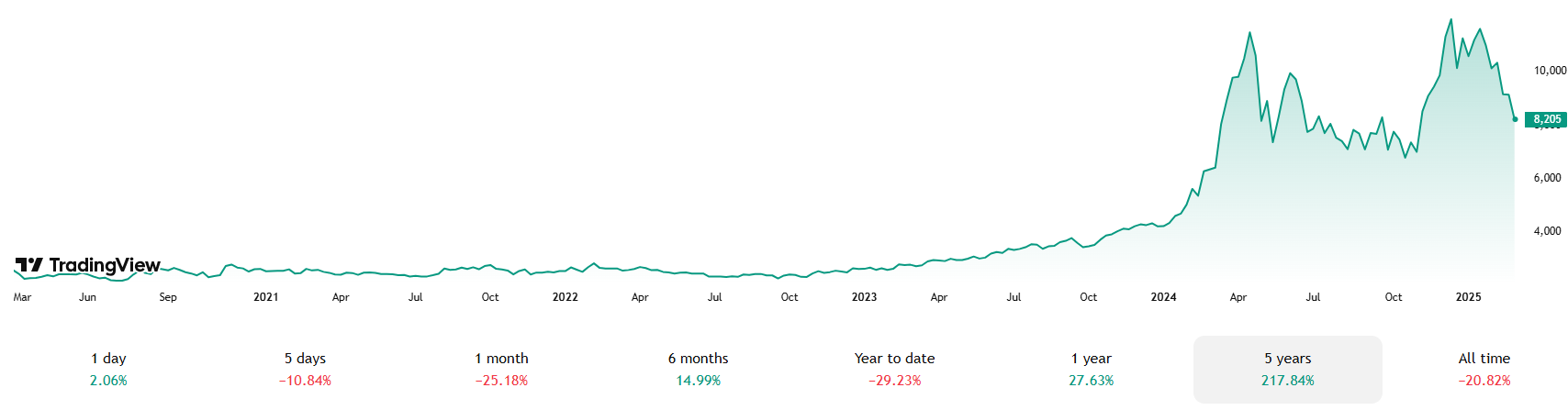
Price Development of Continuous Cocoa Contracts Over the Last 5 Years. (Source: TradingView)*
Positive Forecast
The International Cocoa Organization (ICCO) has significantly contributed to this market development with its latest forecast. After years of deficits, ICCO expects the cocoa market to reach a surplus of 142,000 tons in the 2024/2025 season. Additionally, it stated that global supply will increase to 4.84 million tons, which is nearly 8 percent higher than the estimates for the previous season. This is expected to happen despite challenges faced by farmers in key growing regions. The world's largest producer, Côte d'Ivoire, along with Ghana, has suffered from extreme heat. According to a study by Climate Central, climate change has caused temperatures in West Africa to remain higher than optimal for cocoa trees by 6 to 8 weeks longer over the past decade. The situation was further complicated by irregular rainfall, with last summer experiencing significantly higher precipitation, while winter remained dry. Farmers are also struggling with tree diseases and smuggling. According to ICCO, farmers have managed to better prepare and adapt within their means, leading to these optimistic projections.[1]
Shift in Preferences
The weakening demand has also played a role in cocoa price developments, as last year's high prices turned chocolate treats into a luxury for many consumers. One key indicator of this trend is the decline in cocoa grinding, which has fallen globally according to Barchart.com. In the last three months of 2024, the European Cocoa Association reported a 5 percent decrease, while the Asian Cocoa Association announced that regional demand had dropped to a four-year low. In the U.S., the decline was 1.2 percent. ICCO estimates indicate that this trend will persist, forecasting an almost 5 percent decline this season. Chocolate manufacturers have also responded to record cocoa prices. Swiss chocolatier Lindt announced a double-digit price increase after having already raised prices in 2024. Mondelez even warned consumers to expect significantly more expensive chocolate, with Bloomberg reporting a potential price hike of up to 50 percent. The CEO of Hershey did not provide exact figures but emphasized that such a move would be crucial for the company. Although demand is currently declining, this may only be a short-term phenomenon. According to Fortune Business Insights, the cocoa market is projected to grow from $48 billion in 2022 to $68 billion by 2029.[2]
Coffee at Record Highs
The opposite trend can be observed in coffee prices, which have surged to record highs since the beginning of the year. Continuous Arabica coffee contracts on ICE reached an all-time high on February 13, 2025, at $425 per pound (approximately 0.45 kg). By March 6, 2025, they had fallen below $400, yet this still represented a 23 percent increase for the year. For comparison, contract prices were 115 percent lower last year, while five years ago, they traded at 252 percent lower levels.*
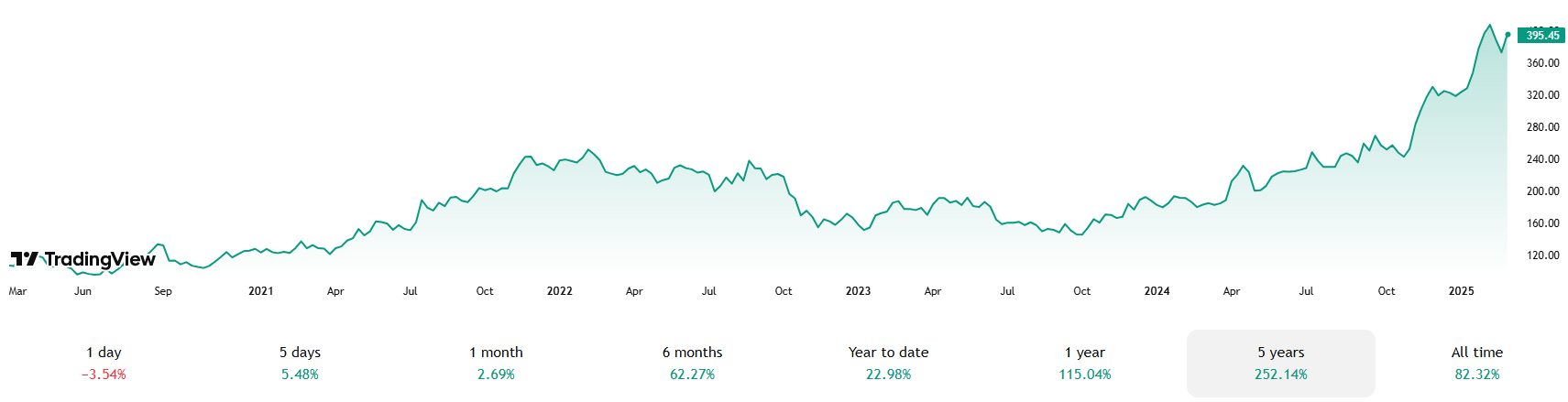
Price development of continuous Arabica coffee contracts over the past five years. (Source: TradingView)*
Robusta coffee contracts peaked at $5,846 per ton on the same trading day and dropped to $5,537 by March 6, 2025. Compared to Arabica, Robusta’s performance was even stronger. Over the past year, its price increased by 74 percent, and looking at a five-year period, it recorded a gain of more than 358 percent.*
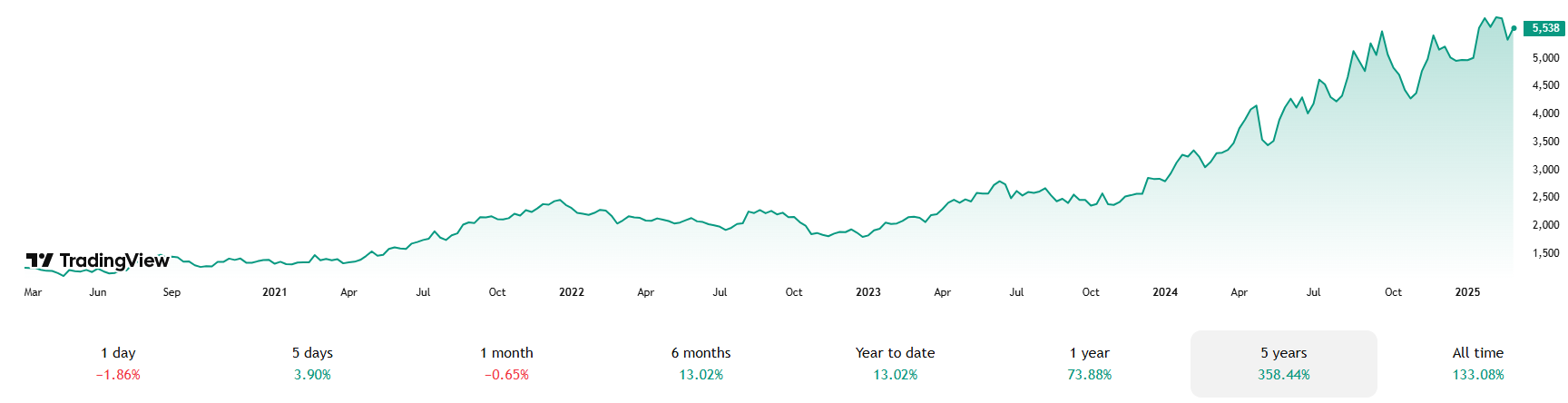
Price development of continuous Robusta coffee contracts over the past five years. (Source: TradingView)*
Restrictions and Panic
According to Reuters, trader panic may be behind these developments. Brazil, which holds the largest share of global Arabica production, has restricted further coffee sales as its current reserves have already dropped by 85 percent. Coffee prices are also being supported by adverse weather conditions affecting Brazil. The country has suffered from the worst droughts in its history, along with wildfires that destroyed coffee plantations. These unfavorable events led Volcafe to lower its Arabica production estimate for 2025 and 2026 by 11 million bags compared to its September forecasts. On the other side of the globe, the world's largest Robusta producer, Vietnam, has been hit not only by droughts but also by strong typhoons accompanied by floods. High exchange prices are already being felt by coffee lovers in the U.S., where Arabica prices on store shelves in January increased by 2.5 percent compared to 2024, while Robusta prices rose by as much as 7 percent. As reported by Yahoo Finance, Robusta's role in instant coffee, which is a cheaper alternative, means that the price increase is not as shocking as it might appear “on paper.” Several suppliers, such as illy caffè and Keurig Dr Pepper, are considering further price increases. It will be interesting to see how coffee prices evolve and whether the commodity will face the same fate as orange juice or cocoa, where demand gradually starts to decline.
Price development of frozen concentrated orange juice futures contracts for May 2025 delivery over the past 5 years. (Source: Investing.com)*
https://www.investing.com/commodities/orange-juice
* Past performance is not a guarantee of future results.
[1], [2] Forward-looking statements are based on assumptions and current expectations, which may be inaccurate, or on the current economic environment, which may change. Such statements are not guarantees of future performance. They involve risks and other uncertainties that are difficult to predict. Actual results may differ materially from those expressed or implied in any forward-looking statements.
