









Difficult Times Persist
Kering reported a decline for the first quarter, with its revenues reaching just under EUR 4 billion, representing a year-on-year decrease of 14 percent. During the observed period, Kering operated over 1,780 stores in total, but due to the unfavourable situation, it had to close 25 stores and 50 boutiques. Looking at individual regions, the trend was also negative. Asia and the Pacific continued to experience a significant decline of 25 percent, just as at the end of last year. Sales also slowed in Western Europe and North America, where they fell by 13 percent, and in Japan by 11 percent. Kering remains vigilant toward global challenges, and as stated by its CEO, François-Henri Pinault, the company is focusing on achieving its goals and regaining its position, but at the same time expects the luxury sector to face problems this year as well.
Mixed Results for the Brands
A similar scenario applies to Gucci, which makes up the largest portion of Kering’s revenue. Its sales for the reported period dropped by 24 percent to EUR 1.6 billion, mainly due to lower store foot traffic. The situation on the Chinese market, once a major contributor to the profits of many brands, is particularly complex in this case. Despite this, according to Kering, Gucci is gaining momentum, and its new handbag collection has sparked market interest. Yves Saint Laurent saw an 8 percent decline, and revenues from other luxury houses—such as McQueen—fell by 11 percent. On the positive side, Bottega Veneta posted a 4 percent increase, men's suit brand Brioni saw double-digit growth, and the eyewear and cosmetics segments reported a 4 percent rise in total sales. The group’s jewellery houses also delivered solid performance.
New Director Didn't Help the Stock
Another quarter of negative results was reflected in Kering’s stock price on the Paris stock exchange, where it fell by roughly 6 percent after results were published on April 24, 2025. However, by the end of the trading day, that loss had narrowed to less than 1 percent, with shares closing at EUR 173.24 each. The company’s shares have been in the red for an extended period. Since the beginning of the year, they’ve lost 26 percent, partly due to a drop in mid-March when a new creative director was appointed for Gucci. Demna, as he’s known in the world of luxury, was not well received by investors due to a controversial Balenciaga ad that depicted a child in a sexual context. For comparison – during the same period last year, the stock experienced an even steeper drop of 48 percent, while over the past five years, shares have declined by a total of 63 percent.*
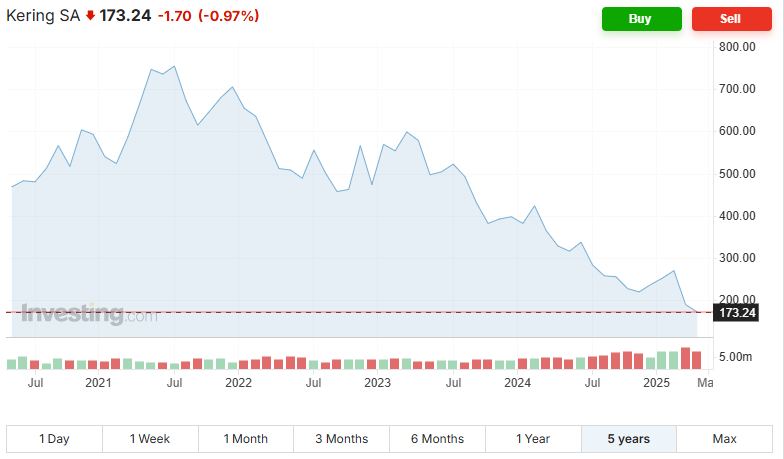
Kering's share price development over the past 5 years. (Source: Investing.com)*
Growth hurdles persist
A weak economic environment, high inflation, and changing consumer behaviour have long created headwinds for the entire luxury sector. Added to this are tariffs, which may not have an immediate negative impact but could become a problem in the longer term. Many companies, in an effort to reduce the impact of U.S. trade policy, are planning to shift production to the States—something unlikely to happen for European luxury. Instead, brands will resort to raising prices. The Chinese market is no longer what it used to be, so companies have shifted their focus to wealthy American consumers, who also won’t be thrilled to pay more for the “made in Europe” label, especially if recession fears emerge.
Hermès emerges as the winner
According to recently released results, even LVMH—owner of brands like Louis Vuitton and Dior—is still struggling with declining sales. However, its revenues fell by a much smaller share than Kering’s, only 2 percent to EUR 20.3 billion. The worst-performing segments were fashion and leather goods, wines, and spirits, while only watches and jewellery showed growth. On the other hand, Hermès’ situation is much more positive. Its consolidated revenue rose by 9 percent to EUR 4.1 billion. Growth was recorded across all regions—nearly 13 percent in Europe, 11 percent in the U.S., 17 percent in Japan, and 1 percent in Asia. Sales in the Middle East were also noteworthy, with revenues growing by 14 percent. Hermès owes this performance to the high exclusivity and price tags of its products, as well as its approach to customers, and expects its growth to continue. [1] The next in line is Richemont, which will publish its results in mid-May. Its last quarterly report showed a year-on-year increase in revenue, but a drop compared to Q3, so it will be interesting to see how it performed during the first three months of 2025.
* Past performance is not indicative of future results.
[1] Forward-looking statements are based on assumptions and current expectations that may prove to be inaccurate, or on the current economic environment, which may change. Such statements are not guarantees of future performance. They involve risks and other uncertainties that are difficult to predict. Actual results may differ materially from those expressed or implied in any forward-looking statements.
