









The first chapter of the fiscal year 2026 entered the company’s history by crossing a fundamental threshold, when quarterly revenues, according to data provided by CNBC, exceeded the level of 50 trillion KRW for the first time in history. This almost threefold year-on-year increase was accompanied by a fivefold increase in operating profit, resulting in a record operating margin of 72 percent. Although these parameters appear unprecedented, the subsequent market reaction was marked by a high degree of caution. A slight mismatch between the actual results and the even more ambitious expectations of analysts from the London Stock Exchange Group (LSEG) led to a subsequent correction in the value of the shares by 0.9 percent.* This development illustrates that in the current phase of the market, any hint of failing to achieve absolute perfection is perceived by investors as a signal for increased caution.
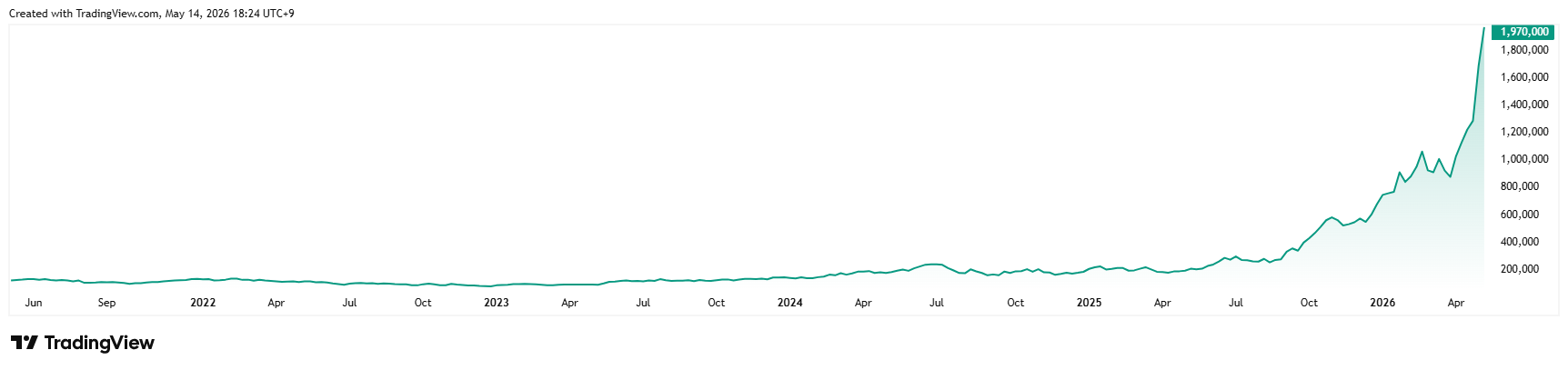
Performance of SK Hynix’s share price over the past 5 years*
HBM
At the core of this successful quarter is dominance in the segment of high-bandwidth memory (HBM). SK Hynix currently controls more than half of the global market for these components, while its close connection with Nvidia’s ecosystem creates significant barriers for competitors. In an environment where demand for AI infrastructure systematically exceeds supply, customers’ attention has shifted from price sensitivity to the absolute priority of securing supply continuity. It is precisely this market imbalance that has enabled the company to benefit from its technological lead and strengthen its position as a leader whose solutions are practically irreplaceable for modern data centers.
The race in innovation
The company’s technological lead is most clearly visible in the context of competition. SK Hynix managed to provide samples of the most advanced sixth-generation memory, HBM4, almost a year ahead of its main competitor, Samsung. This time advantage is crucial for the upcoming wave of AI architectures, which are moving from the phase of model training to their immediate use in practice. The company’s ability to anticipate this shift and prepare its product portfolio in time confirms its competence not only in mass production, but above all in the strategic planning of future technological standards.
Limits of growth
The path to further development, however, runs into limits defined by physical and systemic constraints. The management of SK Group openly warns of a global shortage of wafers, which could restrict the entire semiconductor sector until the end of the current decade. Since demand for HBM solutions is growing faster than production capacities can be expanded, the company announced a massive investment of 19 trillion KRW into a new facility in its home country of South Korea. This step represents a necessary response to the expected deficit, overcoming which requires a long-term investment vision and precise management of capital expenditures. In addition to internal challenges, the company must also manage risks connected with a complex geopolitical environment, where tensions in key regions pose a risk to the stability of supplies of strategic raw materials. Although SK Hynix has implemented robust measures to diversify sources of helium, bromine, and tungsten, the global interconnectedness of the industry makes external influences a factor of high importance.
For investors
From an investment perspective, SK Hynix represents a unique intersection between the stability of an established industrial giant and the growth potential of a technological pioneer. Its current dominance in the HBM segment gives the company a strong negotiating position, while the announced investments in future capacities signal an ambition to maintain this lead even under competitive pressure. The company’s future success will be defined by its ability to balance the extreme demands of innovation with the need for physical expansion of production in an era where production limits are the greatest barrier to achieving the full potential of artificial intelligence.
* Past performance is not a guarantee of future results.
