


Creating tissue is one thing; ensuring that an entire organ functions in the human body is another. As specialist publications in the journal Nature point out, vascularisation, safety and long-term functionality remain particular challenges. Routine transplants of entire laboratory-grown organs are therefore not yet a reality. Meanwhile, demand for a solution is growing. According to the US portal OrganDonor.gov, approximately 109,000 people were waiting for a transplant in the United States in July 2026. Spain’s National Transplant Organization (ONT) states that more than 53,000 patients were on waiting lists in the European Union at the end of 2025. For companies, this is a strong incentive to explore new solutions and potentially increase their revenues.
United Therapeutics: Research Backed by Profits
The most prominent publicly traded player is United Therapeutics, whose shares can be traded on NASDAQ. Its subsidiary Miromatrix is developing biologically engineered organs. In January 2026, the company announced the results of the first phase of the miroliverELAP study – a device containing an engineered liver outside the body that temporarily supported patients with liver failure. The company is also working on transplants of organs from genetically modified animals. According to an October announcement, it opened a third specialised manufacturing facility in Texas. For investors, however, what matters is that United Therapeutics already generates revenue from medicines. According to results released on 4 November 2026, its third-quarter revenue reached $832.5 million, up four percent year on year. Net profit was $258.6 million. Looking at its five-year performance, the company’s shares are in positive territory.*
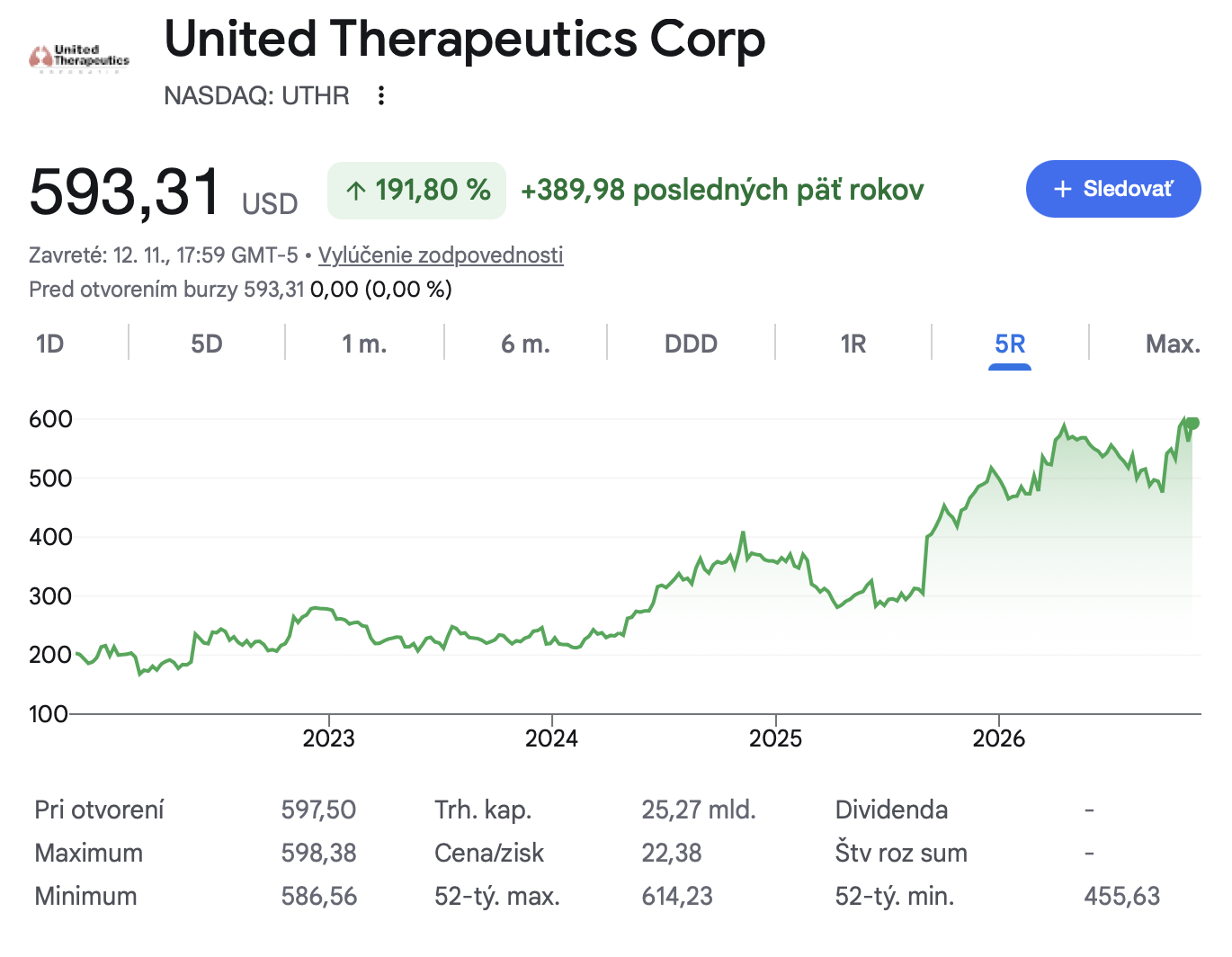
Chart: Performance of United Therapeutics Corp. over the past 5 years. (Source: Google Finance)*
3D Systems: A Bet on Manufacturing Tools
Another avenue is offered by 3D Systems, whose shares are traded on the NYSE. It is a partner of United Therapeutics in developing ULung bioprinted lungs. The project is still at the preclinical stage. However, the company already sells three-dimensional printing technologies for healthcare and industry. According to its November report, third-quarter 2026 revenue reached $99.3 million, up nine percent year on year. Nevertheless, it reported a net loss of $33.5 million. If bioprinting succeeds, it could gain new customers. Investors, however, must also take into account the risks associated with its current business.
BICO Group: Already Selling Bioprinting Products
Through its CELLINK brand, BICO Group already supplies bioprinters and biomaterials to research laboratories. Unlike developers of entire organs, it does not have to wait for the first successful transplant to have customers. According to results released on 11 November 2026, its quarterly revenue rose by 20.2 percent to SEK 465.2 million. Nevertheless, it reported a net loss of SEK 220.4 million, also affected by asset impairments. The opportunity lies in growth in the market for research tools, while stable profitability remains an open question.
CollPlant: An Interesting Material, an Uncertain Direction
Israel’s CollPlant Biotechnologies has developed human collagen produced by plants that can be used in tissue bioprinting. According to its September report, however, it generated revenue of just $108,000 in the second quarter of 2026 and reported a net loss of $2.7 million. Moreover, following its acquisition of LightSolver, it entered the field of photonic computing technologies. In November, it announced plans to change its name to OptiPhi Computing. Its shares are therefore no longer a pure bet on regenerative medicine.
Who Could Profit from the New Era of Medicine?
Of the four companies mentioned, United Therapeutics has the advantage of a profitable business and direct involvement in developing replacement organs. 3D Systems and BICO offer exposure primarily to the tools needed for bioprinting. Given its weak revenues and change in strategy, CollPlant is the most speculative alternative... However, clinical results, regulatory approvals and manufacturing costs will be decisive. Great medical potential does not yet mean guaranteed future returns for investors. It is precisely the ability to turn promising technology into sustainable revenues that will show who ultimately becomes a true leader in this field.
* Past performance is not a guarantee of future results
