









In the most recent quarter, AMD demonstrated exceptional resilience and a strong growth trajectory. Total revenues reached USD 10.27 billion, representing a year-on-year increase of 34 percent. This result exceeded the consensus of analysts from the London Stock Exchange Group (LSEG), who had forecast a more conservative level of USD 9.67 billion. An even more compelling view emerges when focusing directly on profitability. Adjusted earnings per share (EPS) of USD 1.53 significantly surpassed expectations, which had been set at USD 1.32. Net income alone thus tripled year-on-year, demonstrating the company’s ability to efficiently convert revenues into real value for shareholders.
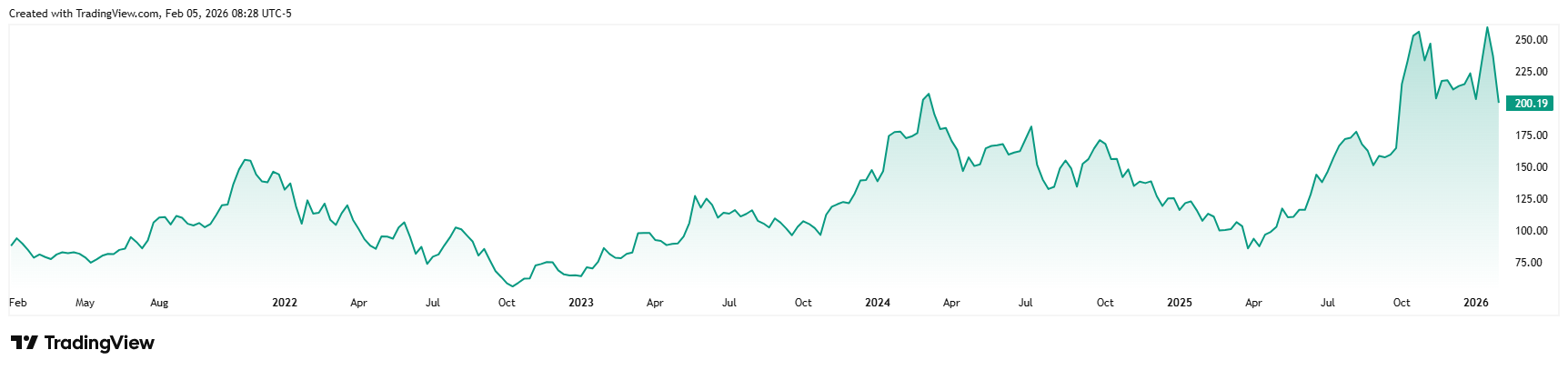
AMD share price performance over the past five years
Where Is the Company Performing Best?
The company’s success during the observed period is not the result of a single product, but rather reflects the direct effect of a diversified portfolio that responds promptly to global digitalization. A dominant role was played by the data center segment, which recorded revenues of USD 5.4 billion and a year-on-year increase of 39 percent, driven by massive demand for AI accelerators and server processors as part of the modernization of corporate infrastructures. In parallel, the Client & Gaming division, which includes processors for personal computers and laptops, achieved revenues of USD 3.9 billion. This 37 percent increase compared to last year confirms the successful expansion of the Ryzen product line, which is systematically increasing its market share at the expense of traditional competitors. Overall ecosystem stability is further supported by the embedded systems segment, which, with revenues of USD 950 million, shows a moderate but stable growth trend.
Why Did the Shares Decline?
Despite outstanding results, AMD shares experienced their worst trading day since 2017, resulting in a decline in market value of 17 percent.* However, the cause cannot be found in any weakening of fundamental indicators. Investors, encouraged by the massive expansion of AI, had anticipated a more ambitious outlook for the first quarter of 2026. Forecast revenues of USD 9.8 billion, although still above analysts’ original estimates, were perceived by the market as an insufficient signal in the context of the ongoing boom. Uncertainty was also heightened by export controls to China, where regulations are expected to lead to a nearly 75 percent drop in sales of specific chips.[1]
Strategic Outlook and Innovation
In response to current risks, future prospects are focused on finalizing the production of the MI450 chip and integrating the comprehensive Helios AI system, with deliveries scheduled for the second half of the year. At the same time, partnerships with giants such as OpenAI and Oracle are a positive signal, confirming the maturity of AMD’s technological solutions, which thus represent a fully-fledged alternative to Nvidia’s infrastructure for leaders in the field of generative artificial intelligence. Finally, it is equally important to highlight the words of AMD’s management. “Artificial intelligence is accelerating at a pace that exceeds my original expectations. Demand for server CPUs is currently extremely strong, as companies around the world are modernizing their data centers,” said CEO Lisa Su.
* Past performance is not a guarantee of future results.
[1] Forward-looking statements are based on assumptions and current expectations that may be inaccurate or based on the current economic environment, which may change. Such statements are not guarantees of future performance. They involve risks and other uncertainties that are difficult to predict. Actual results may differ materially from those expressed or implied in any forward-looking statements.
