









Why Are They Important?
The space environment is not designed for conventional electronics. Repairing or replacing components in orbit, as we know it on Earth, is not possible. Companies therefore have to develop and manufacture specially designed systems suitable for such conditions, including radiation-resistant semiconductors capable of operating reliably for many years. The failure of a single component can jeopardise an entire mission or potentially destroy critical equipment. The growing number of satellites in orbit could mean increasing demand for components, not to mention the rising requirements for computing power. Last year, 324 orbital launches took place. By comparison, according to Space Stats data, there were only 86 in 2015. In light of this growth, rocket reusability is becoming a key topic, with the aim of reducing costs.
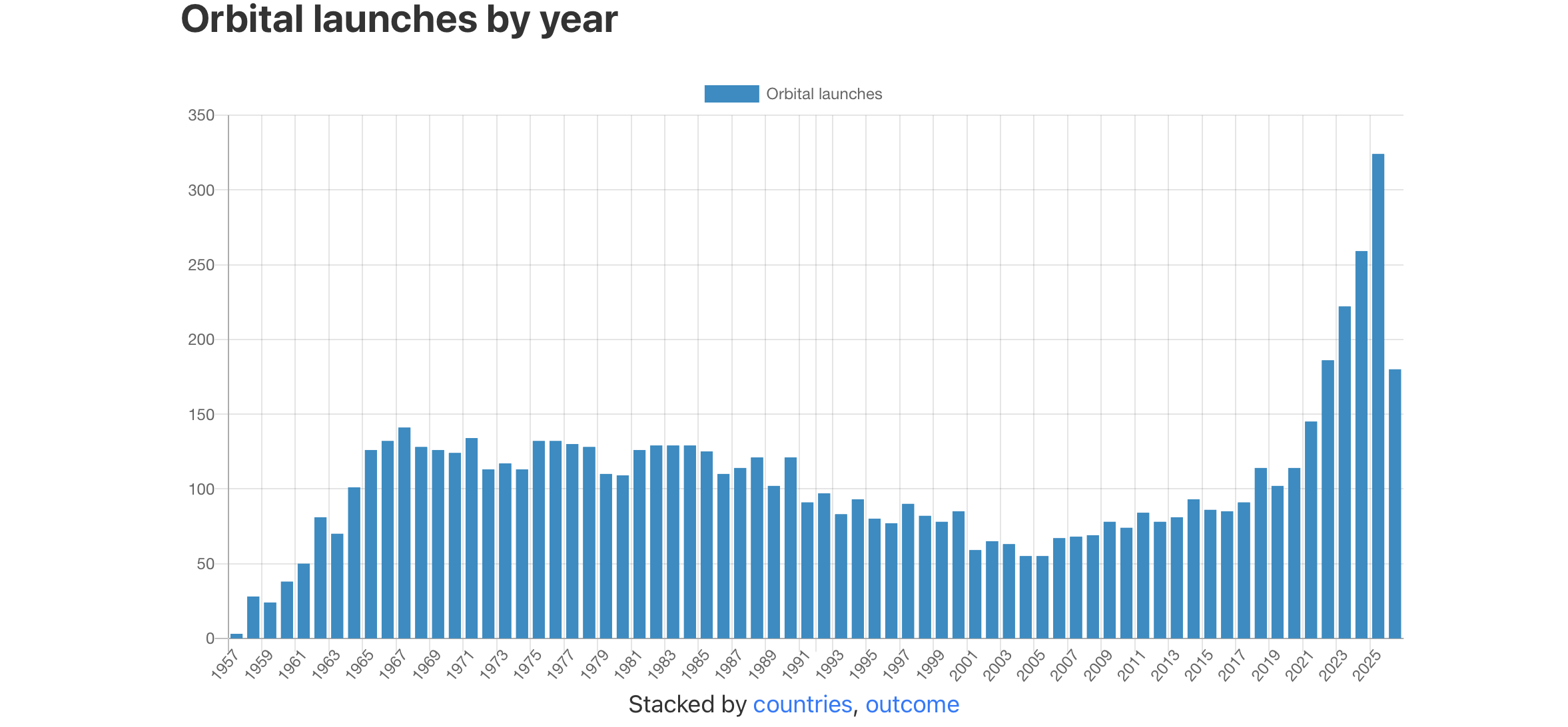
Chart: Historical development of the number of orbital launches from 1957 to 2025 and launches carried out so far in 2026. (Source: Spacestatsonline.com)
No Fuel, No Launch
Propulsion systems and fuel are also essential parts of the entire process, without which no rocket could reach or operate in orbit. Traditional systems use refined kerosene and cryogenic liquid oxygen, but methane has increasingly become a focus in recent years. When burned, methane produces fewer deposits and can make rocket maintenance between missions easier.
Essential Communication
Another investment opportunity lies in operators that provide services to customers on Earth through satellites. These include navigation services, satellite communications, as well as Earth observation imagery. Satellites can provide data on weather, agriculture, energy, transport and security. With the development of artificial intelligence, the volume of data, its interconnectivity and its potential applications continue to expand.
A Wide Range of Applications
The space economy is relatively young, but investor confidence in its future is strong. It represents an interconnected ecosystem of companies, technologies and commodities that offers a wide range of investment opportunities. An interesting advantage for investors may also be the fact that these technologies are used in industries such as manufacturing, defence and aviation, which can reduce an investment’s dependence on a single sector and expand its long-term potential and opportunities.
