










There is high competition in the electric vehicle market, which is good for consumers and the industry as they try to catch up with each other and come up with innovative ways to attract new customers. A related factor is the price cuts that became a trend among electric vehicles earlier this year. Elon Musk saw it as a good strategy to make his product more attractive to buyers first, with his company Tesla slashing the prices of selected models. In addition, it has renewed orders for the Model 3 long-range in the United States, the current price is $ 47,240, which is 18.5 percent less compared to the August 2020 price. The order list is too long, according to Musk, and interested buyers will have to wait for the new models.
Cutting prices may not be the right decision
Ford CEO Jim Farley has expressed concern about this phenomenon, especially after the automaker's second price cut for the Mustang Mach-E to compete with Tesla's Model Y. According to him, this strategy could ultimately devalue the product and weaken the brand at resale. Last month, the federal electric vehicle tax credit for the Mach-E was cut in half to $3,750 from $7,500. Too much discounting, though Ford plans to continue it, could make the flagship model in the electric vehicle field less exclusive. The company's investment in a new manufacturing center in Memphis, Tennessee, will help ensure the steady quality of its vehicles.
Porsche wants to raise prices
German manufacturer Porsche, on the other hand, has announced that it will raise prices for its luxury products. In the second half of 2023, it will be by 4 to 8 percent in Europe and the US. The increase will come as a result of more difficult supply of semiconductors and some parts for the Taycan model, but at the same time the company expects the situation to improve in the coming months as it has seen an 18 percent increase in orders. The company went public in September 2022, separately from its parent company Volkswagen, and posted sales of €10.1 billion and operating profit of €1.84 billion in the first quarter of 2023, beating expectations.
Ford would like to maintain a stable position this year
Ford Motor Company posted strong sales and profit for the first quarter, mainly due to demand for trucks and SUVs. The CEO wants the company to be "boringly predictable" and unlike Tesla, Ford will not prioritize electric vehicle sales volume at any cost. In the first quarter, the internal combustion vehicle business did better than the electric vehicle business, and the company wants to take advantage of the strong demand for the electric F-pickup in particular and boost production to 150,000 vehicles by the end of the year. In addition, it plans to set aside $1.5 billion to $2 billion for restructuring charges in 2023 and, as part of that, close several unprofitable stores and cut one in nine jobs in Europe.
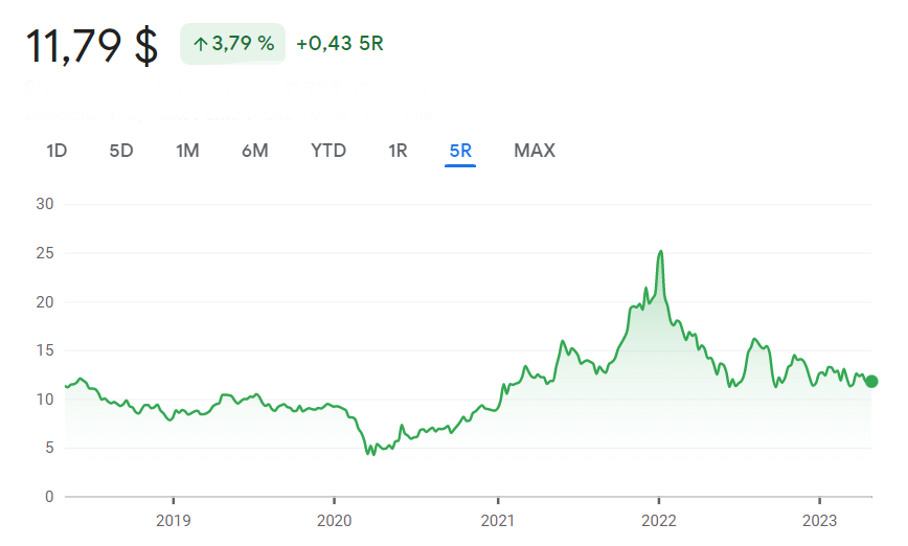
Ford Motor Company's stock performance over the past five years (Source: Google)
Volvo has made a big push in the Chinese market
Carmaker Volvo Cars announced that it achieved a 10 percent year-on-year sales increase, selling 51,976 vehicles. The increase was driven by strong sales in China, where they increased by 46 percent. The European market, which is Volvo's largest, saw sales rise 5 percent, while sales in the U.S. fell 4 percent. Electric vehicles accounted for 17 percent of total sales, up nearly 100 percent from last year, and sales of all rechargeable models, including non-electric models, were up 28 percent.
Electric motors hand in hand with internal combustion?
Automakers such as Ford, Porsche and Volvo Cars continue to make significant progress in the sales and production of both electric and internal combustion engine vehicles. It is safe to say that electric vehicles are steadily breaking through in the car market and are making alarming gains on combustion engines based on their rapid growth. Investments for the development of better electric powertrains appear to be rational and we are likely to see constant growth in the coming months. The Chinese market, where many car companies have found fertile ground, will play a significant role in this respect[1].
[1] Forward-looking statements are based on assumptions and current expectations, which may be inaccurate, or on the current economic environment, which may change. Such statements are not guarantees of future v
