









Between April 21, 2026, and early May 2026, the market witnessed an impulsive surge in the value of financial contracts linked to potatoes. According to data provided by Trading Economics, the price of these derivatives, traded in the form of CFDs and futures, rose within less than a month from an initial EUR 2.11 to EUR 18.50 per 100 kg, representing an increase of more than 700 percent.* In the context of the commodities market, this was an extremely unusual fluctuation.
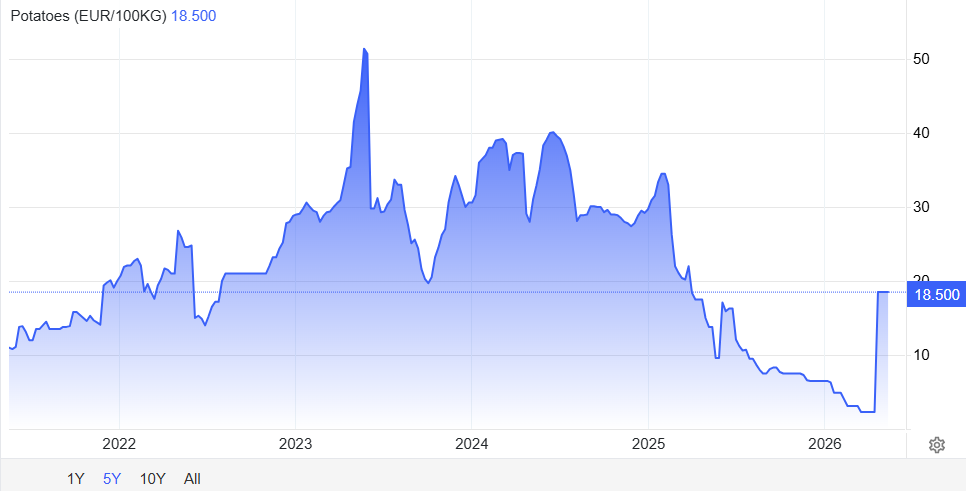
Price performance of derivatives linked to 100 kg of potatoes over the last 5 years. (Source: Trading Economics) *
Digital Currencies Lost Their “Drive”
For comparison, during the same period the digital asset market showed only modest growth. Ethereum (ETH) gained approximately 6.2 percent, even lagging behind the broader cryptocurrency market, which increased by 10.8 percent. While crypto assets faced relatively weak investor interest, speculative capital moved massively into agricultural futures contracts, where investors sought opportunities arising from growing geopolitical tensions. *
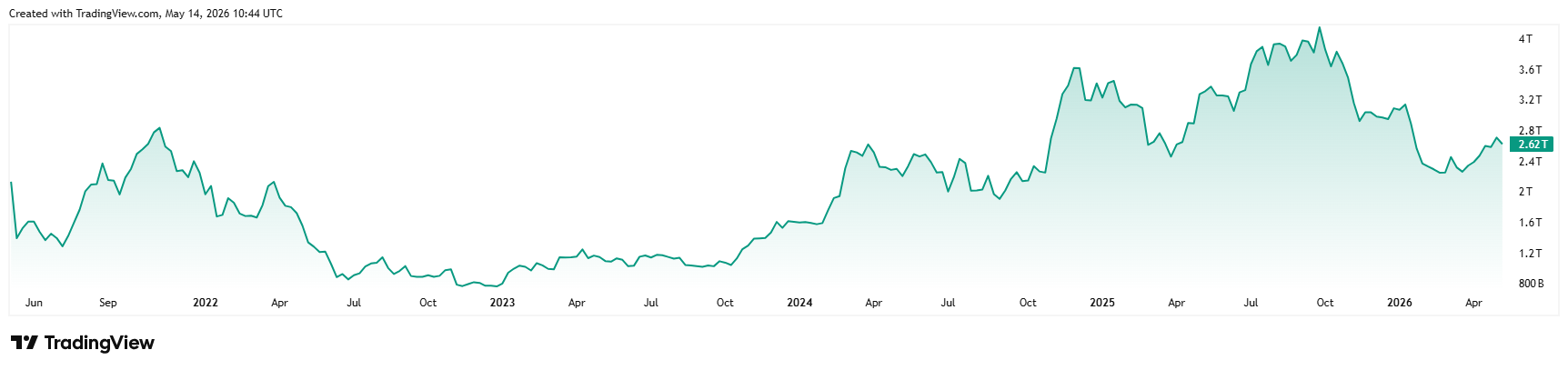
Performance of the cryptocurrency sector over the last 5 years. *
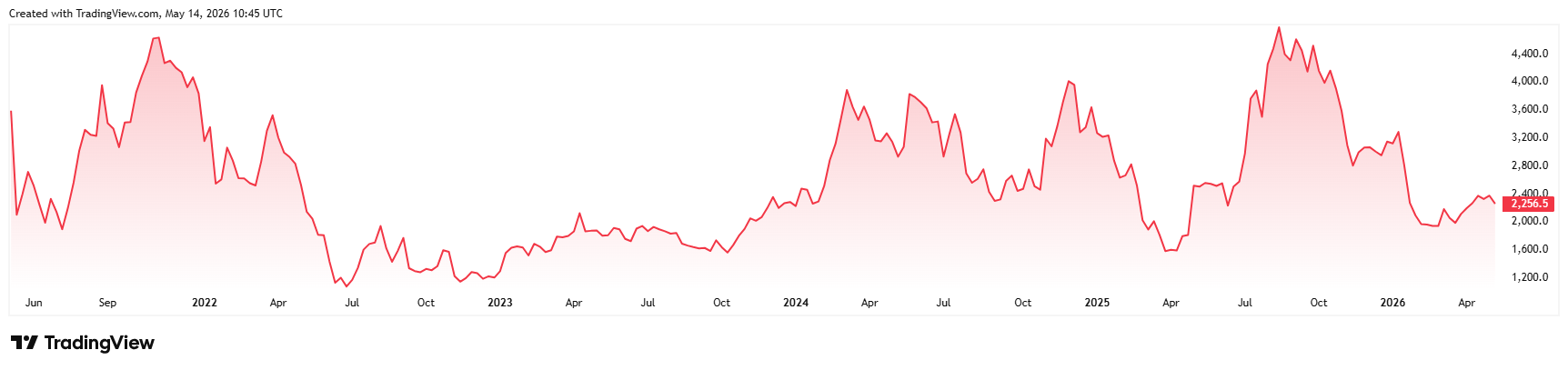
Ethereum price performance over the last 5 years. *
Divergence Between Derivatives and Real Production
The main factor causing concern when observing the rise in potato prices is the disconnect between the financial market and physical reality. The European market is currently experiencing a deep production surplus known as the “Potato Flood 2025.” Strong harvests in key countries such as the Netherlands, Belgium, France, and Germany created enormous stockpiles in storage facilities that would normally push prices downward. This surplus was clearly reflected in the physical market, where prices declined, especially for lower-quality production.
The Agricultural Producer Price Index Speaks Clearly
The overall agricultural producer price index in the EU fell by 5.2 percent in March 2026, with potatoes among the segments experiencing the steepest declines. Nevertheless, financial contracts linked to these commodities continued to rise.* This paradox emerged as a result of aggressive repricing of futures contracts, which began incorporating geopolitical risks associated with Iran and the threat of disruptions to global trade routes and fertilizer supplies. Investors effectively bet on fears of future shortages while ignoring the market’s current oversupply.
Speculative Pressure
From the perspective of long-term market stability, the current level of derivative prices appears unsustainable. Farmers are struggling with rising energy and fertilizer costs, making production unprofitable at the current declining prices on the physical market. If geopolitical risks do not materialize into actual supply disruptions, futures prices will likely decline and move closer to the real market situation. [1]
* Past performance is not a guarantee of future results.
[1] Forward-looking statements are based on assumptions and current expectations that may prove inaccurate, or on the current economic environment, which may change. Such statements are not guarantees of future performance. They involve risks and other uncertainties that are difficult to predict. Actual results may differ materially from those expressed or implied in any forward-looking statements.
