









Looking at pure financial performance, both companies delivered their strongest growth in recent years according to data provided by CNBC. Alphabet recorded a year-on-year increase in revenue of 20 percent to nearly 110 billion USD, which is its fastest quarterly growth since 2022, while net profit reached 62.57 billion USD – 5.11 USD per share. Meta grew even more significantly, with revenue of 56.3 billion USD representing a year-on-year jump of 33 percent, the strongest result since 2021. Despite the fact that Meta reported net profit of 26.8 billion USD and its adjusted earnings per share of 7.31 USD significantly exceeded the expected 6.79 USD, from Meta’s point of view, investors unfortunately focused on other metrics.
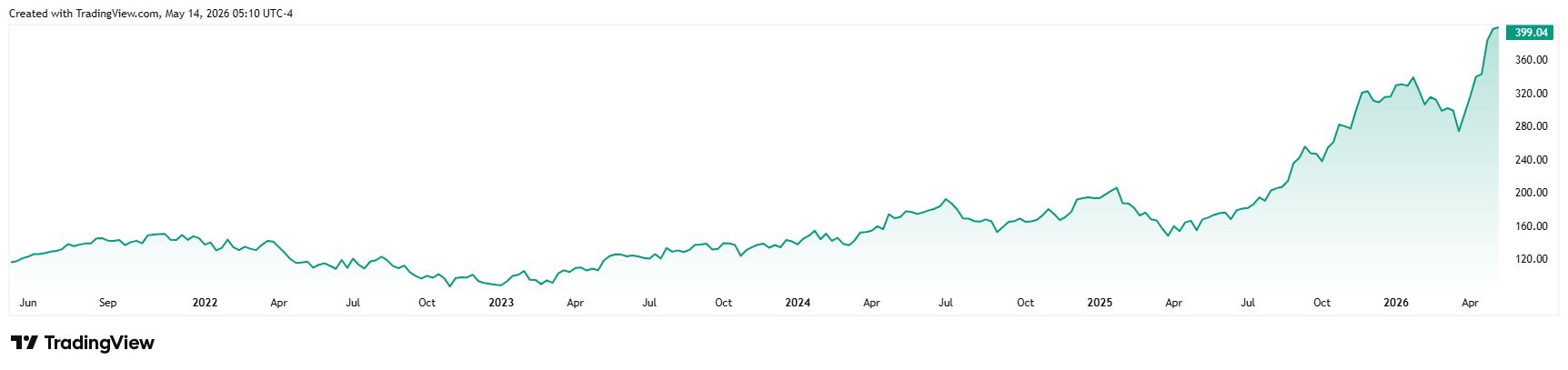
Performance of Alphabet’s share price over the past 5 years*
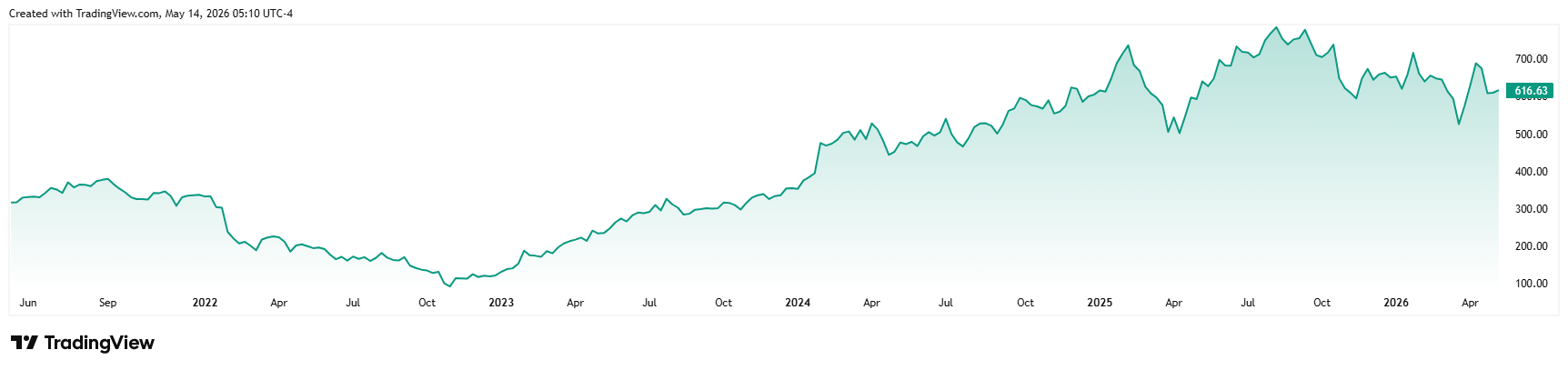
Performance of Meta’s share price over the past 5 years*
The bill for the future
The main stumbling block turned out to be capital expenditures on AI infrastructure, known as capex. As part of their results, both companies announced that they plan to invest significantly more in technology than originally expected. Alphabet raised its outlook for 2026 to the level of 180 to 190 billion USD, while Meta expects expenditures in the range of 125 to 145 billion USD. Although Meta plans to spend nominally less, the market perceives these investments as riskier. The reason is the lack of a direct channel for generating revenue from AI, which Google has. In Meta’s case, it is expected that the return on these huge investments will appear only secondarily through higher advertising revenues or new user engagement, which in the eyes of Wall Street represents an uncertain bet on the future. [1]
Cloud as a direct money-making machine
A related and at the same time key factor that provides Alphabet with greater investor confidence is its robust cloud division. Google Cloud grew by an incredible 63 percent in the first quarter, which was well above expectations, and enterprise AI solutions became the main driver of this success. Alphabet is thus able to immediately convert its billion-dollar investments in chips and data centers into real revenues from corporate customers who are looking for computing capacity for their own AI models. Proof of this enormous demand is also the backlog, meaning the volume of already contracted future revenues, in the cloud segment, which reached an astronomical 460 billion USD. In the context of last year, this value almost doubled.
Technological independence
In addition to cloud, Alphabet has another ace up its sleeve in the form of its own TPU chips, which are increasingly successfully competing with graphics processors from Nvidia. This vertical integration allows the company to reduce the costs of training models, while at the same time offering clients unique infrastructure. Meta is trying to do something similar and is developing its own chips in cooperation with Broadcom, but for now it remains largely dependent on hardware purchases from AMD and Nvidia. It is precisely this dependence, combined with the global shortage of memory and rising component prices, that increases Meta’s operating costs, which ultimately constantly forces it to raise its capital expenditure outlook. [2]
Why is Alphabet winning this battle for now?
The overall picture is also complemented by developments in the user base. While Alphabet benefits from record activity in the search segment supported by AI elements, Meta had to acknowledge a quarter-on-quarter decline in daily active users to 3.56 billion, which was below market expectations. Although Mark Zuckerberg defends high spending as necessary for future growth and maintaining strategic flexibility, investors have clearly shown that they prefer Google’s model, where AI investments are already today a tangible catalyst for profit. Looking ahead, both companies also indicate that the pace of investment in 2027 will be even faster, which means that the battle for investor confidence will directly depend on who can monetize AI technologies faster and more effectively in real business. [3]
* Past performance is not a guarantee of future results.
[1] – [3] Forward-looking statements are based on assumptions and current expectations, which may be inaccurate, or on the current economic environment, which may change. Such statements are not a guarantee of future performance. They involve risks and other uncertainties that are difficult to predict. Results may differ materially from those expressed or implied in any forward-looking statements.
